Embedded Software Development Tool Trends
-

- Tweet
- Pin It
- Condividi per email
-

One day a traditional debug tool will just upload data … Well, this could be the dark side for an Embedded Systems debug and test tool manufacturer such as iSYSTEM. However, there is also a more realistic view telling us that future functionality of a development and test tool will be more software than hardware. Ok, this is nothing magic and it is a general trend for years now. Implicitly it tells us that even if a tool will just upload data, it has to upload and display a mass of data at high speed. Not only a challenge for tool but also for PC manufacturers. USB 3.0 may be an answer here. In addition to that, debugging tools have to support the new high-speed serial interfaces implemented on todays and future micro controllers (e.g., AURORA). Challenging will be the way how the data is collected and pre-analyzed as well as displayed in real-time on the PC.

Debugging without cable. iSYSTEM’s Bluetooth Debugger
In 1971, a first microcontroller (MCU) was introduced. At that time, Embedded Software development was done with very limited tool support, mostly in Assembler, no PC. The first in-circuit emulator connected to a PC was brought to the market in the early 80ties, iSYSTEM did so in 1988.
Developing and manufacturing a software development and test tool for embedded microcontroller application development, a tool manufacturer has to have a close relationship with semiconductor vendors to be able to come up with the right tools in time and with the highest possible integration. The world of microcontroller has changed a lot since the very beginning in terms of complexity, number of cores, speed, power consumption, and variety. So did the software development tools. Emulation is replaced by on-chip debugging; a tool must be reusable over several projects and microcontroller architectures, more and more test and measurement functionality is built in, a flexible integration of such tools within the software development and test process is mandatory.
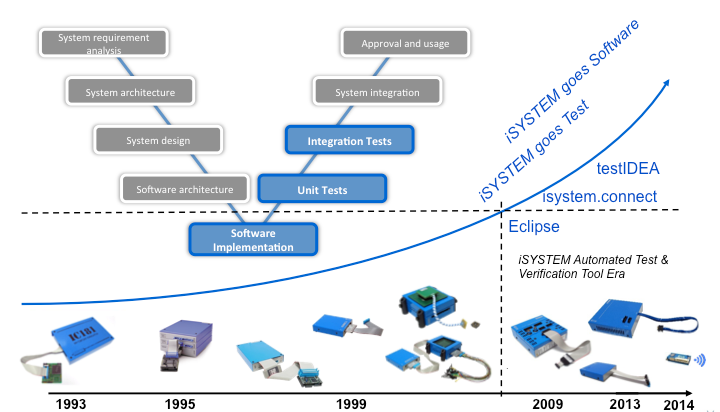
More and more functionality of a debugger can be found in software
To build a professional debug tool today, it is not enough to know all about the details of a micro controller. The core know-how of a tool vendor has to be extended towards process know-how within their customer base. Why? Because todays tools have to be seamlessly integrated in such processes and have to support automating big portions of the process steps. They also have to fit in the context of market specific standards, e.g., safety standards and have to come up with answers to model based development and testing, requirements traceability, as well as connectivity to simulator software and hardware and other layers of the V diagram. These requirements do have an impact on the actual and future functionality set of debug tools already today:
Connectivity (open and public APIs) – Tool vendors like iSYSTEM have to provide generic interfaces to integrate these tools in their customers’ development and test processes so that this functionality can be used in full. The interfaces have to support a wide range of tasks (development, test, verification and validation of software and hardware). The trend is towards supporting many different programming languages (C, C++, C#, JAVA) and script languages (Python, Perl, TCL) to “remotely control” the development tool from within another application (also customer-specific). In principle, specific process sequences can thus be automated both during development and test.
Software Testing Capabilities – Real-time Testing – Testing is a requirement in several (safety) standards, e.g. IEC 61508 and its derived standards ISO 26262, DO-178B, IEC 62304 and so forth. Standards and standardization have a tremendous influence on the development cycle and especially on the amount of testing. Instead of purchasing an additional tool and in order to test as early and close as possible to the hardware today’s debuggers should offer an integrated testing functionality.
This is what iSYSTEM implemented as real-time testing. It does not require code instrumentation or any test driver. This enhancement to iSYSTEM’s debug and analyzer tools allows to generate and execute test cases from inside the development environment. No test driver is necessary. Without compiling/linking/downloading a test case again and again, the test is executed on the real hardware. Additionally features of iSYSTEM’s debug and trace tools e.g. tracing, profiling, code coverage can be integrated in the test processes.
Multicore Processor Support – Multicore processors have found their way into a wide range of applications. Here as well, suitable development tools will offer solutions to support the development and test of dedicated multicore applications. There are still a lot of open questions for all parties including semiconductor vendors, end customers, tool vendors, universities etc. On a long run real multicore based application development and testing will change not only tools but also the development and test process within a company.
ARM/Cortex Market – This is the most growing market since a while now. Lots of embedded application are already based on this microcontroller architecture, more will follow. Cyber-
Physical Systems, Internet of Things (IOT), buzzwords for embedded systems, but an indication that shows already today that lots of small and mid-size embedded systems will be present on the market in the future. Most of them will be based on ARM/Cortex. iSYSTEM responds to the strong growth of the Cortex microcontroller market, offering customers a simple and cost-efficient entry into the Cortex embedded world. This is accomplished with a free IDE version called winIDEA Open with integrated support for iSYSTEM iTAG debugger hardware and 3rd party hardware such as Segger J-Link or ST Link from ST Micro. A GNU compiler for Cortex-M is also supplied. Extensiv technical support as well as the use of additional compilers is available through an upgrade to a regular winIDEA version.
Erol Simsek, iSYSTEM AG
Contenuti correlati
-
 Microprocessori multicore a 64-bit per l’“intelligent edge”
Microchip Technology ha introdotto la gamma di MPU PIC 64 per soddisfare le crescenti esigenze degli odierni progetti embedded Leggi l’articolo completo su EMB93
-
 5 prodotti OSHW per progetti embedded flessibili e personalizzabili
Optare per un hardware open source significa credere nel potenziale di innovazione, accelerazione e trasformazione di ciascun prodotto o progetto, che deriva da una maggior capacità di controllo sulla tecnologia e dalla condivisione di conoscenze. Le prospettive...
-
 AMD annuncia Embedded+
Embedded+ è il nome di una nuova piattaforma architetturale di AMD che combina i processori AMD Ryzen Embedded con i SoC adattivi Versal su un’unica board integrata. L’obiettivo è quello di accelerare il time-to-market delle applicazioni Edge...
-
 Le soluzioni Embedded: istruzioni per l’uso
Di Sandro Mascetti – CEO di MAS Elettronica Nell’attuale scenario di Industria 4.0. le soluzioni embedded sono diventate un must have. Grazie alle numerose applicazioni che offrono, queste soluzioni sono molto diffuse e conosciute. I sistemi embedded...
-
 Hardware debug per la functional safety
I test sulla functional safety giocano un ruolo fondamentale nello sviluppo delle ECU installate sui veicoli. I test eseguiti in varie fasi aiutano lo sviluppatore a garantire la conformità agli standard ASIL. In questo articolo una panoramica...
-
 Le risorse di Mouser per l’embedded
Mouser Electronics mette a disposizione dei progettisti una piattaforma online con una serie di risorse per il mondo embedded. Si tratta del centro di risorse sull’Elaborazione Embedded che viene costantemente aggiornato con informazioni sulle applicazioni embedded attraverso...
-
 Sicurezza: un problema volutamente ignorato
Nel momento in cui le normative e i regolamenti che disciplinano la sicurezza entrano in vigore non solo in Europa, ma in tutto il mondo, le aziende devono necessariamente aggiungere funzioni atte a garantire la sicurezza dei...
-
 Come rendere sicuro e semplice l’aggiornamento OTA con TUF
L’ambiente dei dispositivi embedded è ancora il bersaglio di continue minacce. Più un dispositivo è connesso e più funzioni intelligenti offre all’utente, maggiore sarà la “superficie di attacco” per eventuali minacce informatiche Leggi l’articolo completo su Embedded...
-
 Come semplificare l’uso della visione artificiale
Una nuova workstation sviluppata congiuntamente da Kontron e Robotron utilizza un approccio di tipo “no code” per eliminare uno dei principali “colli di bottiglia” che ostacolano l’utilizzo pratico delle soluzioni basate sull’intelligenza artificiale Leggi l’articolo completo su...
-
 Uno sguardo all’evoluzione dell’elaborazione ai margini della rete
L’edge computing sta guadagnando sempre più popolarità nel dominio IoT. Nel 2018 è stata una delle principali tendenze tecnologiche che ha costituito la base per la prossima generazione di aziende digitali. Parallelamente, date le enormi quantità di...
Scopri le novità scelte per te
-
Microprocessori multicore a 64-bit per l’“intelligent edge”
Microchip Technology ha introdotto la gamma di MPU PIC 64 per soddisfare le crescenti esigenze degli odierni...
-
5 prodotti OSHW per progetti embedded flessibili e personalizzabili
Optare per un hardware open source significa credere nel potenziale di innovazione, accelerazione e trasformazione di ciascun...

News/Analysis Tutti ▶
-
 Nuova collaborazione tra Farnell e Hailo
Farnell ha annunciato di aver stretto una nuova partnership a livello globale con Hailo,...
-
 Consystem rinnova il sito web
Consystem rinnova la propria presenza digitale con un nuovo sito progettato per offrire una...
-
 Siemens acquisisce Precision Innovations
Siemens ha siglato un accordo per l’acquisizione di Precision Innovations, azienda specializzata in software...
Products Tutti ▶
-
 Driver per motori passo-passo da Toshiba
Toshiba Electronics Europe ha sviluppato TB67S531FTG, un driver per motori passo-passo bipolari bifase a...
-
 Melexis presenta un nuovo driver per ventole
Melexis ha ampliato la famiglia di driver per ventole di raffreddamento MLX90412 con un...
-
 Driver radiation-hardened da Infineon
RIC70115 è un driver per Hemt (High-Electron Mobility Transistor) di Infineon. Peculiarità di questo...