Murata enables better Wi-Fi 6E and Wi-Fi 7 antenna design
-

- Tweet
- Pin It
- Condividi per email
-
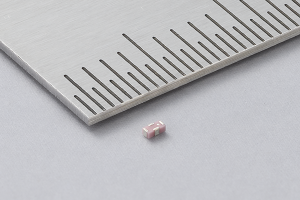
Murata has announced its new Parasitic Element Coupling Device. This solution improves antenna efficiency by magnetically coupling the parasitic element with the antenna and is the world’s first solution designed for Wi-Fi 6E and Wi-Fi 7 products. For designers of smartphones, tablets, network routers, game consoles, and other compact electronics, it enables them to build more efficient antennas – a key requirement for many modern space-constrained devices.
To develop products conforming to Wi-Fi 6E and Wi-Fi 7 standards, which utilize high-speed wireless communication, multiple high-performance antennas must be installed in electronic devices to improve communication speed and quality.
However, as the dimensions of heatsinks and batteries expand, as processors become more advanced, the available space for mounting antennas tends to decrease.
Consequently, there is a need for smaller antennas. But there is a technical limitation, in that the efficiency of wide-band antennas decreases when they are miniaturized. Therefore, designers need a solution that achieves both miniaturization and high performance.
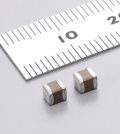
Murata’s solution is a parasitic element coupling device, made with its multilayer technology as a four-terminal surface-mount component of just 1.0 x 0.5 x 0.35mm.
Murata’s parasitic element coupling device connects the feeding antenna to its parasitic elements more effectively than is possible through free space. It acts as a tiny coupling device whose compact size enables strong coupling performance without the use of magnetic materials, which would be inappropriate at the targeted operating frequencies. One side of the coupling device is connected, at very low insertion loss, between a device’s RF circuitry and its main antenna. The other side is connected between the ground and the parasitic element. The resultant, more direct coupling enables the resonance characteristics of the parasitic element to be added to those of the feeding antenna. As a result, it enables more efficient operation across a broader frequency range or on multiple discrete bands.
The device helps to combat that when an antenna is made smaller, the coupling between it and the parasitic elements is reduced, while the coupling between the parasitic elements and the ground is increased. By sustaining the coupling between the feeding antenna and parasitic element, parasitic element coupling device enables designers to use miniaturized antenna design methods without impacting the communication band of efficiency.
The feeding antenna can cause an impedance mismatch when used over a wide band, leading to a degradation in wireless performance. In addition, when an antenna with a mismatched impedance is connected to a communication circuit using a long cable, the long cable can promote the impedance mismatch, causing larger insertion loss than expected and significantly reducing wireless communication performance. By using the device, you can improve antenna matching and reduce performance degradation in wireless communications even when using long cables.
Contenuti correlati
-
 Murata: nuovi convertitori DC-DC ad alto isolamento
Murata Manufacturing ha annunciato la serie di convertitori DC-DC isolati MGJ1T, una nuova gamma da 6 kV DC e 1 W per montaggio superficiale. La serie è stata progettata per alimentare circuiti gate driver high-side e low-side...
-
 Murata amplia l’offerta di sensori IMU
Murata Manufacturing ha annunciato l’ampliamento della sua famiglia di sensori SCH1600 con il modello SCH1633-D05, un’unità di misura inerziale (IMU) ad alte prestazioni a sei gradi di libertà (6DoF). Il dispositivo combina un giroscopio e un accelerometro...
-
 Le tecnologie di Murata a embedded world 2026
Murata Manufacturing ha annunciato la sua partecipazione a embedded world 2026 a Norimberga. Il tema sarà “Promuovere l’intelligenza integrata nella mobilità, nella connettività e nell’intelligenza artificiale” e l’azienda mostrerà alla manifestazione come le sue soluzioni di alimentazione...
-
 La nuova generazione di router Wi-Fi 7 di D-Link
D-Link ha presentato la sua nuova gamma di prodotti Wi-Fi 7 dual-band, articolata su diverse linee. Il router G572 5G NR BE7200 combina connettività 5G NR e Wi-Fi 7 per aree senza fibra. Il produttore sottolinea che...
-
 Westermo: access point Wi-Fi 7 per ferrovie
Ibex-1520 e Ibex-3520 sono due nuovi access point Wi-Fi 7 (802.11be) di Westermo, destinati a rispondere alle esigenze di connettività ad alta velocità in ambito ferroviario. I due dispositivi combinano tecnologia di nuova generazione con affidabilità e...
-
 Murata presenta un MLCC C0G da 15 nF e 1,25 kV
Murata ha realizzato un nuovo condensatore ceramico multistrato (MLCC) caratterizzato da una capacità di 15 nF, una tensione nominale di 1,25 kV e caratteristiche C0G in un formato 3225M (3,2 mm x 2,5 mm/1210). Le caratteristiche di...
-
 Murata nominata Top innovator per la tecnologia USCD
Murata ha annunciato di essere stata selezionata come Top Innovator nella categoria Digital dei CLEPA Innovation Awards. Il riconoscimento è legato alla tecnologia UltraSonic Clearing Device (USCD) di Murata, che è attualmente in fase di sviluppo. Questa...
-
 Il Wi-Fi 7 di Intel da Rutronik
Rutronik ha annunciato la disponibilità di due soluzioni Wi-Fi 7 (IEEE 802.11be) di Intel per la comunicazione wireless. Si tratta dei moduli BE200 e BE202 che offrono velocità di trasmissione dati fino a 5,8 Gbit/s, latenze particolarmente basse...
-
 EnGenius presenta ECW520 per le PMI
EnGenius Technologies ha presentato il nuovo Access Point ECW520 Cloud Managed Tri Band 2x2x2 – 5800Mbps – 2.5GbE. Si tratta di un prodotto con tencologia Wi-Fi 7 concepito per mercati come, per esempio , quello delle PMI che...
-
 La tecnologia per il wellness nel nuovo whitepaper di Murata
“Evolving Healthcare Technology: Murata’s Role in Advancing Wellness” è un whitepaper di Murata relativo al settore del wellness. Il documento approfondisce temi su questo settore e per l’assistenza sanitaria, evidenziando il ruolo dei componenti elettronici per realizzare...
Scopri le novità scelte per te
-
Murata: nuovi convertitori DC-DC ad alto isolamento
Murata Manufacturing ha annunciato la serie di convertitori DC-DC isolati MGJ1T, una nuova gamma da 6 kV...
-
Murata amplia l’offerta di sensori IMU
Murata Manufacturing ha annunciato l’ampliamento della sua famiglia di sensori SCH1600 con il modello SCH1633-D05, un’unità di...
News/Analysis read all ▶
-
 KYOCERA AVX launches new solderless WTB card-edge connectors
KYOCERA AVX launched the new 9169-000 Series single-piece wire-to-board card-edge connectors. The new 9169-000...
-
 Renesas completes acquisition of Transphorm
Renesas Electronics Corporation announced that it has completed the acquisition of Transphorm. With the...
-
 Linxens and Nocturnal join forces to accelerate the development of innovative medical devices
Linxens, global expert in the design and manufacture of electronic components, and Nocturnal, specialized...
Products read all ▶
-
 Advantech launches ITA-168/178 series
Advantech launches its latest compact and fanless edge computers—the ITA-168 and 178 series. These...
-
 Solid Sands launches SuperGuard Amsterdam version 1.2
Solid Sands has launched an updated version of its SuperGuard product, the world’s first...
-
 A new add-on board for global tracking and telematics from MIKROE
MIKROE has launched 4G LTE&GNSS Click, a compact add-on board designed for advanced global...