From Europe 5 million Euros on organic semiconductors
-

- Tweet
- Pin It
- Condividi per email
-
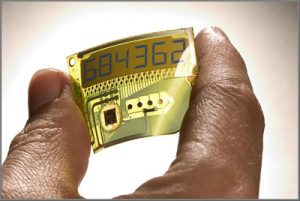
EXTMOS (EXTended Model of Organic Semiconductors), a €5 million pan-European collaborative research project led by the University of Bath, will help develop new organic semiconductor materials and additives that can be printed onto flexible film to create devices that are low cost, flexible, wearable and lightweight.
Organic materials are used in applications such as flexible displays, billboards and low energy diffuse lighting and wearables. They also have exciting potential for the Internet of Things, where electronics are embedded in objects and transfer data without human intervention.
The EXTMOS project, part of the EU Horizon 2020 research and innovation programme, aims to reduce the time and effort involved in manufacturing and testing new materials and hence lower the production costs.
Project leader Professor Alison Walker, from the University of Bath’s Department of Physics, explained: “Currently the process of developing and testing of new materials is very time-consuming because of the high number or permutations of structure open to organic chemists. This project aims to develop the tools to enhance decision making concerning which materials are synthesised for a given target device performance.
EXTMOS is a pan-European collaboration of 8 academic partners: the universities of Bath, Mons, Bologna, the Karlsruhe Institute of Technology, the research institutes of Nanosciences et Cryogénie of the CEA organization and the Institut Néel in Grenoble, the Max Planck Institut für Polymerforschung, Mainz and Imec, Leuven along with 4 industrial partners: Novaled, FlexEnable, Silvaco Europe and Nanomatch. US advisors are Antoine Kahn, Princeton, Roland Faller, UC Davis, Ana Claudia Arias, UC Berkeley.
ap
Contenuti correlati
-
 5 milioni di euro dall’UE per l’elettronica stampata
L’elettronica stampata, flessibile e realizzata con materiali a base di carbonio offre numerose possibilità di applicazione e l’Unione europea è disposta a finanziare un progetto di quattro anni con 5 milioni di euro. Le potenziali applicazioni comprendono...
Scopri le novità scelte per te
-
5 milioni di euro dall’UE per l’elettronica stampata
L’elettronica stampata, flessibile e realizzata con materiali a base di carbonio offre numerose possibilità di applicazione e...
News/Analysis read all ▶
-
 KYOCERA AVX launches new solderless WTB card-edge connectors
KYOCERA AVX launched the new 9169-000 Series single-piece wire-to-board card-edge connectors. The new 9169-000...
-
 Renesas completes acquisition of Transphorm
Renesas Electronics Corporation announced that it has completed the acquisition of Transphorm. With the...
-
 Linxens and Nocturnal join forces to accelerate the development of innovative medical devices
Linxens, global expert in the design and manufacture of electronic components, and Nocturnal, specialized...
Products read all ▶
-
 Advantech launches ITA-168/178 series
Advantech launches its latest compact and fanless edge computers—the ITA-168 and 178 series. These...
-
 Solid Sands launches SuperGuard Amsterdam version 1.2
Solid Sands has launched an updated version of its SuperGuard product, the world’s first...
-
 A new add-on board for global tracking and telematics from MIKROE
MIKROE has launched 4G LTE&GNSS Click, a compact add-on board designed for advanced global...